
Most american enterprises face mounting pressure to guarantee document compliance while streamlining workflows across global teams. The complexity of meeting modern PDF standards impacts everything from legal archiving to accessibility for Canadian and European partners. Adobe solutions deliver advanced tools for robust validation, metadata management, and regulatory integrity. This guide reveals how PDF standards shape effective enterprise strategies, maximize document reliability, and support secure, compliant operations at scale.
Table of Contents
- PDF Standards Defined And Key Concepts
- Major Types Of PDF Standards Explained
- Essential Features And Compliance Criteria
- Enterprise Use Cases And Legal Frameworks
- Risks, Mistakes, And Compliance Failures
- Optimizing PDF Workflows With Standards
Key Takeaways
| Point | Details |
|---|---|
| PDF Standards Ensure Consistency | PDF standards define technical specifications for creating, processing, and preserving digital documents, ensuring consistency across platforms. |
| Compliance Is Critical | Organizations must adhere to compliance criteria for document integrity, security, and accessibility to avoid legal risks and ensure usability. |
| Strategic Standard Selection | Conducting a thorough audit of document types and aligning PDF standards with specific workflow requirements is essential for effective document management. |
| Ongoing Risk Management | Establishing a cross-functional compliance team and implementing automated validation processes can help mitigate the risks associated with PDF standard failures. |
PDF Standards Defined and Key Concepts
PDF standards represent a comprehensive framework of technical specifications and guidelines that define how digital documents should be created, processed, and preserved. These standards ensure consistent document rendering, accessibility, and long-term digital preservation across different software platforms and devices. The International Organization for Standardization (ISO) plays a critical role in developing and maintaining these crucial technical standards.
At their core, PDF standards encompass several key dimensions that govern document integrity and interoperability. Professional competence standards demonstrate how systematic guidelines can drive quality and measurable outcomes. These dimensions include document structure, metadata management, compression algorithms, security protocols, and archival preservation requirements. Organizations rely on these standards to guarantee that PDF files remain readable, searchable, and structurally intact regardless of the technological environment.
The primary PDF standards currently in use include PDF/A for archival preservation, PDF/X for print publishing, PDF/E for engineering documents, and PDF/UA for universal accessibility. Each standard addresses specific industry requirements, ensuring that digital documents meet rigorous technical specifications. For instance, PDF/A mandates complete self-containment of documents, preventing external dependencies that could compromise long-term readability.
Pro Tip: Document Management Strategy: When implementing PDF standards across enterprise systems, develop a comprehensive mapping of which specific PDF standards apply to different document types in your organization, creating clear guidelines for file creation and preservation.
Major Types of PDF Standards Explained
PDF standards represent a sophisticated ecosystem of technical specifications designed to address diverse document management needs across different industries and use cases. These standards are meticulously crafted to ensure consistent document performance, security, and compatibility across various technological platforms. PDF version specifications continue to evolve to meet increasingly complex digital document requirements.
The primary categories of PDF standards include:
- PDF/A: Focused on long-term digital archiving and preservation
- PDF/X: Specialized for print publishing and graphic arts workflows
- PDF/E: Engineered for engineering and technical documentation
- PDF/UA: Dedicated to universal accessibility and inclusive document design
Each standard addresses specific technical challenges and industry requirements. PDF/A, for instance, mandates complete self-containment of documents, ensuring that all necessary elements for future rendering are embedded within the file. This approach prevents external dependencies that could compromise long-term document readability. PDF/X standards provide rigorous specifications for graphic content, ensuring color management, font embedding, and print-ready configurations that meet professional publishing requirements.

The engineering-specific PDF/E standard supports technical documentation by allowing complex 3D models, engineering drawings, and metadata that are crucial for design and manufacturing processes. Meanwhile, PDF/UA standards focus on creating documents that are fully accessible to individuals with disabilities, incorporating features like proper text alternatives, logical reading order, and compatibility with assistive technologies.
Pro Tip: Strategic PDF Standard Selection: Conduct a comprehensive audit of your organization’s document types and choose PDF standards that align most closely with your specific workflow requirements and long-term preservation needs.
The following table compares the primary PDF standards and their distinctive industry applications:
| PDF Standard | Main Focus | Industries Benefiting | Key Technical Requirement |
|---|---|---|---|
| PDF/A | Long-term Archiving | Government, Legal, Libraries | Complete file self-containment |
| PDF/X | Print Publishing | Printing, Graphics, Media | Color management, font embedding |
| PDF/E | Engineering Docs | Architecture, Engineering | 3D model support, rich metadata |
| PDF/UA | Accessibility | Education, Public Sector | Logical reading order, assistive tech support |
Essential Features and Compliance Criteria
PDF standards are underpinned by rigorous compliance criteria that ensure document integrity, security, and interoperability across diverse technological environments. Comprehensive guidelines for maintaining institutional standards highlight the critical importance of establishing clear, measurable benchmarks for digital document management.
The essential features of PDF standards encompass several key compliance dimensions:
- Document Structure Integrity: Ensuring consistent and predictable document layout
- Metadata Management: Comprehensive and standardized information embedding
- Security Protocols: Encryption, access controls, and permission management
- Archival Compatibility: Long-term preservation and backward compatibility
- Accessibility Requirements: Universal design principles for inclusive document access
Compliancy criteria demand meticulous attention to technical specifications that govern document creation, rendering, and preservation. These standards require precise implementation of technical requirements such as font embedding, color space management, compression algorithms, and metadata consistency. Organizations must implement robust validation processes that verify documents meet specific PDF standard requirements before archival or distribution.
Additionally, compliance extends beyond technical specifications to include comprehensive security and accessibility provisions. Modern PDF standards mandate advanced features like digital signatures, redaction capabilities, and comprehensive accessibility support for users with disabilities. Institutional compliance frameworks emphasize the importance of establishing clear guidelines and self-evaluation mechanisms to ensure consistent adherence to these sophisticated technical and ethical standards.
Pro Tip: Compliance Validation Strategy: Develop automated validation scripts that systematically check PDF documents against specific standard requirements before final archival or distribution, reducing manual review time and minimizing compliance risks.
Enterprise Use Cases and Legal Frameworks
Enterprise PDF standards have become critical infrastructure for organizations seeking to manage digital documents with precision, security, and legal compliance. National open source policy trends demonstrate the growing importance of standardized document management frameworks across global business environments.
The primary enterprise use cases for PDF standards span multiple critical domains:
- Regulatory Compliance: Ensuring documents meet industry-specific legal requirements
- Information Security: Protecting sensitive corporate and client information
- Long-term Archival: Maintaining readable and verifiable document records
- Cross-Platform Compatibility: Supporting seamless information exchange
- Workflow Automation: Streamlining document processing and management
Legal frameworks surrounding PDF standards have evolved to address complex technological and regulatory challenges. Enterprises must navigate intricate requirements that span data protection regulations, industry-specific compliance mandates, and international document management standards. This involves implementing robust validation processes that ensure documents meet both technical specifications and legal requirements across different jurisdictions.
Advanced enterprise implementations integrate PDF standards with comprehensive governance frameworks. Organizations now require sophisticated document management strategies that incorporate digital signatures, comprehensive metadata management, and advanced access control mechanisms. These approaches not only ensure legal compliance but also provide granular control over document lifecycles, supporting critical business processes across global operations.
Pro Tip: Enterprise PDF Compliance Strategy: Develop a centralized policy framework that maps PDF standard requirements to specific organizational and regulatory needs, creating a comprehensive approach to document management and legal compliance.
Risks, Mistakes, and Compliance Failures
Comprehensive analysis of compliance failures reveals that PDF standard implementation challenges extend far beyond technical limitations, encompassing complex organizational and human factors that can compromise document integrity and legal standing.
The most critical risks in PDF standard compliance include:
- Inadequate Validation Processes: Failing to systematically verify document conformance
- Metadata Mismanagement: Incomplete or inaccurate document information tracking
- Security Configuration Errors: Improper access controls and encryption settings
- Version Control Breakdowns: Uncontrolled document modification and tracking
- Accessibility Standard Violations: Neglecting universal design requirements
Organizational compliance failures typically stem from systemic issues rather than isolated technical problems. Compliance risk assessment frameworks demonstrate that most PDF standard violations result from insufficient training, unclear governance structures, and fragmented technological implementation strategies. These failures can lead to significant legal and operational risks, including potential regulatory sanctions, compromised data security, and reduced organizational credibility.
Enterprise environments must recognize that PDF standard compliance is a dynamic, ongoing process requiring continuous monitoring and adaptive strategies. Advanced organizations implement comprehensive risk management approaches that include regular audits, automated validation tools, and robust training programs. These strategies address not just technical compliance but also the human and organizational factors that contribute to potential failures.
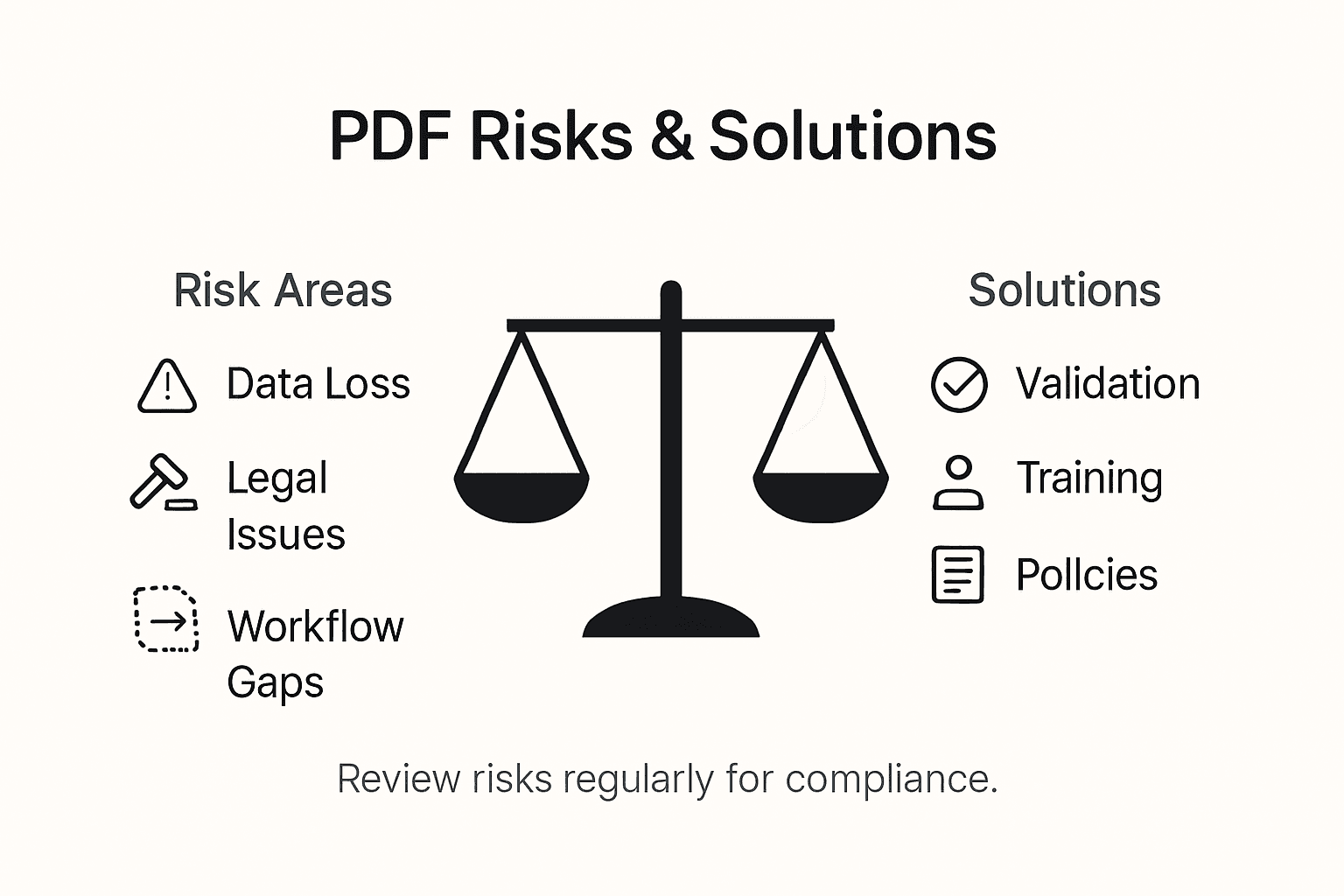
Pro Tip: Compliance Risk Mitigation: Establish a cross-functional PDF compliance team that combines technical expertise, legal knowledge, and organizational governance to create a holistic risk management approach.
This summary highlights common enterprise risks and best mitigation practices for PDF compliance:
| Risk Area | Impact on Organization | Effective Mitigation Strategy |
|---|---|---|
| Validation Gaps | Compliance failures | Automated document conformance checks |
| Metadata Errors | Data retrieval problems | Standardized metadata protocols |
| Security Misconfigurations | Data breaches | Regular security audits |
| Version Control Issues | Lost document history | Robust version control systems |
| Accessibility Violations | Exclusion of users | Accessibility training and validation |
Optimizing PDF Workflows with Standards
Document workflow optimization strategies have transformed how organizations manage and process digital documents, highlighting the critical role of standardized PDF workflows in achieving operational efficiency. Modern enterprises require sophisticated approaches that integrate technical precision with strategic document management principles.
Key strategies for optimizing PDF workflows include:
- Automated Validation: Implementing systematic document conformance checks
- Metadata Standardization: Creating consistent information tracking protocols
- Batch Processing: Developing scalable document transformation capabilities
- Accessibility Integration: Ensuring universal design and usability standards
- Security Enforcement: Implementing robust access control and encryption mechanisms
Advanced organizations recognize that workflow optimization extends beyond technical implementation. Comprehensive PDF workflow protocols demand a holistic approach that combines technological tools, standardized processes, and organizational governance. This means developing integrated systems that can automatically validate document structures, manage metadata, enforce security protocols, and ensure compliance across diverse operational contexts.
Successful PDF workflow optimization requires continuous adaptation and strategic investment in technology and training. Organizations must develop flexible frameworks that can accommodate evolving standards, integrate with existing technological ecosystems, and provide granular control over document processing. This involves selecting appropriate tools, establishing clear governance protocols, and creating adaptive workflows that can respond to changing regulatory and technological landscapes.
Pro Tip: Workflow Design Strategy: Create a comprehensive PDF workflow mapping that identifies each critical processing stage, potential automation opportunities, and compliance checkpoints to streamline your document management approach.
Streamline Your PDF Compliance and Workflow Efficiency Today
Ensuring strict adherence to PDF standards like PDF/A and PDF/UA while optimizing document workflows demands advanced tools tailored to your enterprise needs. Common challenges such as validating document conformance, managing metadata accurately, and enforcing security protocols can cause compliance risks and operational inefficiencies. To overcome these obstacles and confidently meet regulatory and accessibility requirements, you need solutions designed for precision and scalability.
Discover how Mapsoft.com empowers your organization to automate PDF validation, secure sensitive information, and standardize metadata handling with ease. Start optimizing your document management by exploring our specialized offerings in Digital Preservation – and leveraging our full platform at https://mapsoft.com that supports comprehensive PDF editing, conversion, security, and workflow automation. Take control of your PDF workflows now and transform complex compliance into a streamlined and reliable process.
Frequently Asked Questions
What are PDF standards and why are they important?
PDF standards are technical specifications that define how digital documents should be created, processed, and preserved. They ensure consistent document rendering, accessibility, and long-term digital preservation across different software platforms and devices, making them essential for effective document management.
What are the main types of PDF standards available?
The main types of PDF standards include PDF/A (for archival preservation), PDF/X (for print publishing), PDF/E (for engineering documents), and PDF/UA (for universal accessibility). Each standard has specific focuses tailored to meet various industry requirements.
How can organizations ensure compliance with PDF standards?
Organizations can ensure compliance by implementing robust validation processes that systematically check PDF documents against specific standard requirements, maintaining clear metadata protocols, and regularly conducting audits to verify adherence to technical specifications and legal requirements.
What are the risks associated with non-compliance to PDF standards?
Risks of non-compliance include inadequate validation processes leading to compliance failures, metadata mismanagement resulting in data retrieval issues, security configuration errors that could result in data breaches, and accessibility violations that may exclude users with disabilities.