
PDF ISO Standards Explained: The Complete Family
PDF is not one standard but a whole family of them. Here is every PDF-related ISO standard — PDF/A, PDF/X, PDF/UA, PDF/E, PDF/VT and the newer ISO 32000-2 extensions — with a detailed comparison table.
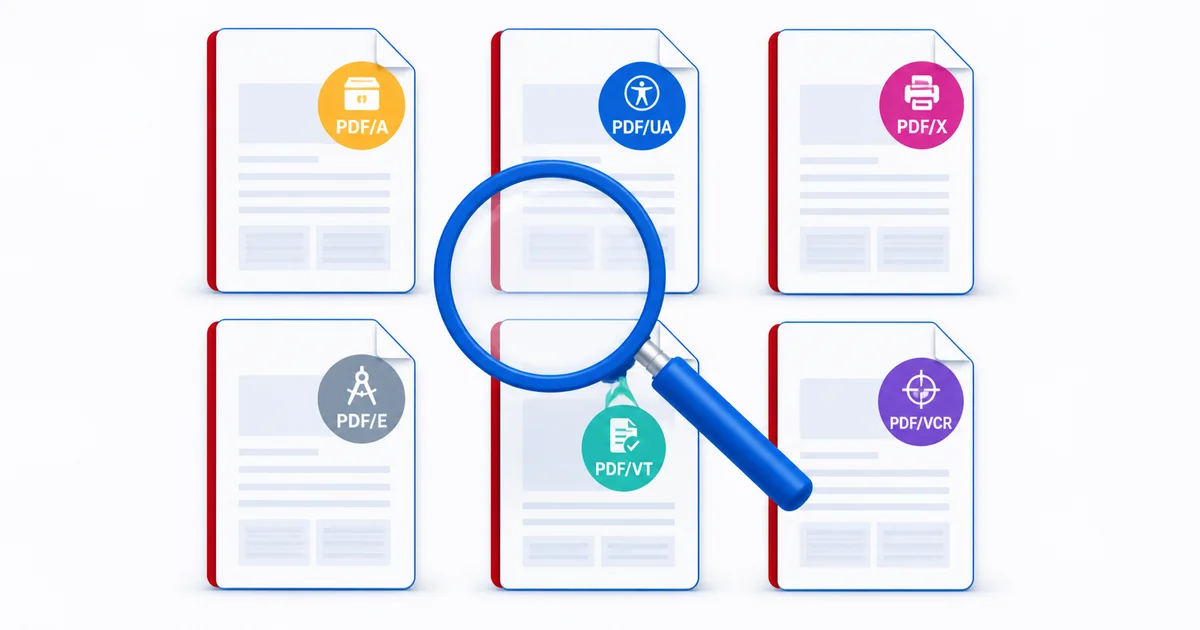
Most people think of PDF as a single thing. In standards terms it is anything but. The core format is defined by ISO 32000, but layered on top of it is a family of more than a dozen separate ISO standards, each one constraining or extending the base specification for a particular purpose — long-term archiving, commercial print, accessibility, engineering, variable-data printing, and more. Knowing which standard does what is essential whenever a contract, regulator, or print house says a file must be “PDF/A-2b” or “PDF/X-4” and you need to know exactly what that means.
This article is a complete, up-to-date reference to the PDF ISO standards as catalogued by the PDF Association. It starts with a master comparison table, then breaks down each family in turn. For a more narrative introduction to the subset standards, see our companion guide to the PDF standards family; for the base specification itself, see exploring the PDF format specification.
How the PDF Standards Fit Together
There is one base specification and everything else builds on it. ISO 32000 defines the PDF file format itself — objects, the cross-reference table, content streams, fonts, transparency, encryption, and so on. Every other standard in the family is either a subset (it forbids certain features and mandates others to guarantee a property such as archivability or print reliability) or an extension (it adds a new capability to the base spec, published as an ISO Technical Specification).
The subset standards are deliberately restrictive. PDF/A forbids anything that would stop a file rendering identically decades from now — no external font references, no embedded scripts, no encryption. PDF/X forbids anything that would make a file print unpredictably — all fonts embedded, colour fully specified, no transparency surprises. The discipline is the point: a conforming file trades flexibility for a guarantee.
The Complete PDF ISO Standards Table
The table below lists the principal PDF-related ISO standards, what each one is for, the base PDF version it builds on, and the most recent edition. Standards prefixed ISO/TS are Technical Specifications — formal ISO extensions to PDF 2.0 rather than full International Standards.
| ISO standard | Common name | Purpose | Base PDF | Latest edition |
|---|---|---|---|---|
| ISO 32000 | The core PDF file format — the base specification everything else builds on. | — | 32000-2 (PDF 2.0), 2020 | |
| ISO 19005 | PDF/A | Long-term archiving and preservation. Self-contained, reproducible files. | 1.4 → 2.0 | 19005-4 (PDF/A-4), 2020 |
| ISO 15930 | PDF/X | Graphic arts and professional print exchange. Predictable, press-ready output. | 1.3 → 2.0 | 15930-9 (PDF/X-6), 2020 |
| ISO 14289 | PDF/UA | Universal accessibility. Tagged structure for assistive technology. | 1.7 / 2.0 | 14289-2 (PDF/UA-2), 2024 |
| ISO 24517 | PDF/E | Engineering documents — CAD, technical drawings, 3D data. | 1.6 | 24517-1 (PDF/E-1), 2008 |
| ISO 16612 | PDF/VT | Variable-data and high-volume transactional printing. | 1.6 → 2.0 | 16612-3 (PDF/VT-3), 2020 |
| ISO 16613 | PDF/VCR | Variable content replacement — template-based variable data substitution. | 2.0 | 16613-1, 2023 |
| ISO 16684 | XMP | Extensible Metadata Platform — the metadata model embedded in PDF (and other formats). | n/a | 16684-1, 2019 (parts 1–4) |
| ISO 19444 | XFDF | XML Forms Data Format — representing form data and annotations as XML. | n/a | 19444-1, 2016 |
| ISO/TS 24064 | — | Extends PDF 2.0 to carry ISO 10303 (STEP) 3D product manufacturing data. | 2.0 | 2023 |
| ISO/TS 32001 | — | Digital signature extensions for PDF 2.0 (additional hash algorithms). | 2.0 | 2022 |
| ISO/TS 32002 | — | Additional cryptographic algorithms for signatures (NIST-P, Brainpool, Edwards curves). | 2.0 | 2022 |
| ISO/TS 32003 | — | Adds AES-GCM authenticated encryption to PDF 2.0. | 2.0 | 2023 |
| ISO/TS 32004 | — | Document integrity protection — detecting tampering independent of signatures. | 2.0 | 2024 |
| ISO/TS 32005 | — | Clarifies use of the standard structure (tag) namespace for tagged PDF. | 2.0 | 2023 |
| ISO/TS 32007 | — | Adds support for embedding glTF 3D models in PDF 2.0. | 2.0 | 2024 |
The rest of this article expands on the most important families, including the individual parts and conformance levels you are most likely to be asked for.
ISO 32000 — The Core PDF Specification
Everything starts here. Adobe published PDF privately from 1993, then handed PDF 1.7 to ISO, which published it as ISO 32000-1:2008. The current edition is ISO 32000-2:2020, commonly called PDF 2.0 — the first version developed entirely under the ISO process rather than controlled by Adobe. It defines objects and the file structure, content-stream graphics operators, fonts, the transparency model, interactive features, encryption, and tagged PDF. Every subset and extension standard below references ISO 32000 and constrains or adds to it.
You can check any file's PDF version online for free with Mapsoft's PDF Hub, and read our PDF 1.7 vs 2.0 comparison for what changed between the two ISO editions.
ISO 19005 — PDF/A (Archiving)
PDF/A is the standard for long-term preservation. The guiding principle is that a file must render identically far into the future without any external dependency, so the standard mandates embedded fonts and colour profiles and forbids encryption, embedded scripts, audio and video, and references to external content. Conformance levels sit within each part: B (basic — reliable visual reproduction), A (accessible — adds tagged-PDF structure), and U (adds Unicode mapping for all text).
| Part | Version | Year | Base PDF | Conformance levels |
|---|---|---|---|---|
| ISO 19005-1 | PDF/A-1 | 2005 | 1.4 | A, B (no transparency, no layers) |
| ISO 19005-2 | PDF/A-2 | 2011 | 1.7 | A, B, U (adds transparency, layers, JPEG2000) |
| ISO 19005-3 | PDF/A-3 | 2012 | 1.7 | A, B, U (as A-2, but allows any file attachment) |
| ISO 19005-4 | PDF/A-4 | 2020 | 2.0 | PDF/A-4, plus 4f (embedded files) and 4e (engineering/3D) |
For practical workflows, see how to convert PDF to PDF/A. Note that PDF/A-3's ability to embed arbitrary attachments is what underpins hybrid invoice formats such as ZUGFeRD and Factur-X, where a machine-readable XML invoice rides inside a human-readable PDF/A.
ISO 15930 — PDF/X (Graphic Arts and Print)
PDF/X is the print industry's exchange standard. It exists to remove ambiguity from the file a designer hands to a print house: every font embedded, every colour fully characterised against an output intent, and no live elements that might render differently on the RIP. The family has grown several conformance levels over two decades; PDF/X-4 remains the workhorse for most modern workflows, with PDF/X-6 the new PDF 2.0–based generation.
| Part | Conformance level | Year | Base PDF | Notes |
|---|---|---|---|---|
| ISO 15930-1 | PDF/X-1a | 2001 | 1.3 | CMYK + spot only; no transparency; fully blind exchange. |
| ISO 15930-3 | PDF/X-3 | 2002 | 1.3 | Allows colour-managed (ICC) device-independent colour. |
| ISO 15930-4 | PDF/X-1a | 2003 | 1.4 | Revised PDF/X-1a on a PDF 1.4 base. |
| ISO 15930-6 | PDF/X-3 | 2003 | 1.4 | Revised PDF/X-3 on a PDF 1.4 base. |
| ISO 15930-7 | PDF/X-4, X-4p | 2010 | 1.6 | Live transparency and layers; p = externally referenced ICC profile. |
| ISO 15930-8 | PDF/X-5g, X-5n, X-5pg | 2010 | 1.6 | Allows external graphics (g) and n-colourant (n) profiles. |
| ISO 15930-9 | PDF/X-6, X-6n, X-6p | 2020 | 2.0 | The current PDF 2.0–based generation of PDF/X. |
If you work in prepress, our notes on PDF colour management and converting PDF colours pair naturally with PDF/X output intents.
ISO 14289 — PDF/UA (Accessibility)
PDF/UA (Universal Accessibility) defines how tagged PDF must be used so that assistive technologies — screen readers in particular — can reliably interpret a document's structure, reading order, and alternative text. It does not replace WCAG; it specifies the PDF-technical requirements that make a PDF accessible.
- ISO 14289-1:2014 (PDF/UA-1) — based on ISO 32000-1 (PDF 1.7).
- ISO 14289-2:2024 (PDF/UA-2) — based on ISO 32000-2 (PDF 2.0), aligning accessibility with the modern structure namespace.
For implementation, the PDF Association's Matterhorn Protocol translates PDF/UA into 136 testable checkpoints. See our overview of PDF accessibility and the recent German PDF/UA mandate for why this standard is increasingly a legal requirement, not a nicety.
ISO 24517 — PDF/E (Engineering)
PDF/E targets engineering and technical-documentation workflows: CAD drawings, geospatial data, and interactive 3D. ISO 24517-1:2008 (PDF/E-1), based on PDF 1.6, supports 3D annotations (U3D/PRC) and measurement. A second-generation PDF/E built on PDF 2.0 has been under development to modernise 3D support; in the meantime much engineering 3D work now also flows through PDF/A-4e and the ISO/TS 24064 STEP extension.
ISO 16612 / ISO 16613 — PDF/VT and PDF/VCR (Variable Data)
PDF/VT is built for variable-data and high-volume transactional printing — think personalised statements, bills, and direct mail where every record differs but the job must print at production speed. It builds on PDF/X and adds document part metadata (DPM) and efficient reuse of repeated content.
- ISO 16612-2:2010 — defines PDF/VT-1 and PDF/VT-2, based on PDF/X-4 and PDF/X-5.
- ISO 16612-3:2020 — defines PDF/VT-3, based on PDF 2.0.
- ISO 16613-1 (PDF/VCR) — Variable Content Replacement, a template-based mechanism for substituting variable content.
Background on the wider technique is in our piece on variable data printing.
Supporting Standards: XMP and XFDF
Two further ISO standards are referenced constantly even though they are not PDF subsets:
- ISO 16684 (XMP) — the Extensible Metadata Platform. Part 1 defines the data model and serialisation; later parts add a RELAX NG schema, JSON-LD serialisation, and an extended data model. XMP is how PDF/A, PDF/X and others record their conformance claim inside the file. See editing PDF metadata.
- ISO 19444 (XFDF) — an XML format for representing form-field data and annotations, used to move form data in and out of PDF forms.
The ISO/TS Extensions to PDF 2.0
Rather than wait for a full revision of ISO 32000, ISO now publishes targeted extensions to PDF 2.0 as Technical Specifications. These are the leading edge of the format, mostly addressing security and 3D:
- ISO/TS 32001 — new digital-signature hash algorithms (e.g. SHA-3).
- ISO/TS 32002 — additional signature cryptography (NIST-P, Brainpool, Edwards curves).
- ISO/TS 32003 — AES-GCM authenticated encryption.
- ISO/TS 32004 — document integrity protection that detects tampering independently of signatures.
- ISO/TS 32005 — clarifies the standard structure namespace for tagged PDF, supporting accessibility.
- ISO/TS 32007 — embedding glTF 3D models in PDF.
- ISO/TS 24064 — carrying ISO 10303 (STEP) product manufacturing information in PDF.
These extensions are expected to be folded into the next full edition of ISO 32000 in due course. For more on the moving parts, see exploring the PDF format specification and our look at the future of PDF.
How to Tell Which Standard a PDF Claims
A conformance claim lives in the file's XMP metadata — for example a PDF/A file records its part and level (such as pdfaid:part=2, pdfaid:conformance=B), and PDF/X files carry a GTS_PDFXVersion entry. Crucially, a claim is not the same as verified conformance: a file can assert PDF/A-2b and still fail validation because of a missing font or an illegal colour space. To actually check, you need a validator such as veraPDF for PDF/A and PDF/UA, or a preflight tool for PDF/X.
Mapsoft's free online PDF analyser lets you inspect a file's metadata and internal structure to see exactly what it claims, and our PDF standards guide walks through reading and trusting those claims in more depth.
About Mapsoft and Our PDF Solutions
Mapsoft specialises in advanced PDF solutions, including a range of Adobe Acrobat plug-ins and custom software development services. We build production pipelines against these ISO standards every day — generating conforming PDF/A for archives, PDF/X for print suppliers, and accessible PDF/UA for regulated content. From PDF library integrations to bespoke plug-ins, we deliver high-quality, standards-compliant results tailored to your requirements. Try our free online PDF analyser tool to inspect any PDF, or get in touch to discuss a conformance project.
Related Articles
PDF Standards: PDF/A, PDF/UA, PDF/X, PDF/E
A narrative guide to the PDF standards family, why PDF has so many of them, and how to choose the right one for the job.
Exploring the PDF Format Specification
What ISO 32000-2 (PDF 2.0) covers, how to navigate the 900-page spec, and what the latest errata mean for developers.
How to Convert PDF to PDF/A
A practical walkthrough of converting documents to the PDF/A archival standard and validating the result.
Working with PDF Standards?
Mapsoft has over 30 years of experience building PDF tools and solutions. Get in touch for expert guidance on conformance.