
Over half of american professionals now say remote work impacts how they approach their careers every day. The shift is not just about convenience or working from any location. It is reshaping workplace culture, team dynamics, and company expectations across industries. Understanding what remote work truly means gives you an edge as technology, productivity, and collaboration all evolve at record speed.
Table of Contents
- Defining Remote Work And Core Concepts
- Emerging Models And Hybrid Work Variations
- Key Technologies Shaping Remote Work
- Enterprise Security, Compliance, And Legal Risks
- Optimizing Productivity In Distributed Teams
Key Takeaways
| Point | Details |
|---|---|
| Understanding Remote Work | Remote work is not just about location; it requires a supportive ecosystem that fosters productivity and team cohesion. |
| Hybrid Work Models | Successful hybrid models blend traditional and remote work, necessitating adaptable strategies that accommodate diverse team structures. |
| Technological Framework | Investing in robust communication technologies is essential for seamless collaboration and productivity in remote settings. |
| Security and Compliance | Organizations must adopt comprehensive security and legal strategies to navigate the challenges posed by remote staffing and data protection. |
Defining Remote Work and Core Concepts
Remote work represents a transformative approach to professional collaboration that transcends traditional office boundaries. Wikipedia defines remote work, also known as telecommuting, as an arrangement where employees perform job duties outside conventional office settings, typically from home or alternative locations. This model leverages advanced information and communication technologies to maintain seamless connectivity with colleagues and clients.
Virtual teams have become the cornerstone of modern remote work strategies. According to Wikipedia, these teams consist of individuals collaborating across diverse geographic locations, utilizing communication technologies like email, instant messaging, and video conferencing to achieve shared organizational objectives. The key characteristics of virtual teams include:
- Geographic dispersion
- Technological interdependence
- Goal-oriented collaboration
- Flexible work arrangements
- Reduced infrastructure costs
The fundamental shift in workplace dynamics emerges from technological advancements that enable professionals to work efficiently from anywhere. These technologies provide robust platforms for communication, project management, document sharing, and real-time collaboration. Professionals can now contribute meaningfully to organizational goals without being physically present in a centralized workspace, breaking traditional constraints of time and location.
Understanding remote work involves recognizing its multifaceted nature. It’s not merely about working from home but creating a comprehensive ecosystem that supports productivity, maintains team cohesion, and ensures individual professional growth. Successful remote work implementation requires strategic planning, appropriate technological infrastructure, clear communication protocols, and a culture that values trust, autonomy, and results over physical presence.
Emerging Models and Hybrid Work Variations
Hybrid work models represent a sophisticated evolution in organizational design, blending traditional office environments with remote work strategies. arXiv research explores the nuanced dynamics of hybrid software teams, revealing how strategic configurations combining co-located and remote work can profoundly influence team cohesion and overall performance.
Remote staffing has emerged as a critical approach for organizations seeking flexible workforce solutions. According to Wikipedia, this strategy involves hiring employees through third-party vendors to work remotely, focusing on integrating long-term team members who perform core business functions. The key variations in hybrid work models include:
- Flexible scheduling
- Rotational office attendance
- Distributed team structures
- Location-independent collaboration
- Customized work arrangements
The complexity of hybrid work extends beyond simple location strategies.
Organizations must develop sophisticated frameworks that balance technological infrastructure, communication protocols, and individual team member preferences. This requires creating adaptive systems that support seamless collaboration, maintain productivity, and foster a sense of connection regardless of physical workspace.
Successful hybrid work models demand a holistic approach that transcends traditional workplace boundaries. Companies must invest in robust technological platforms, cultivate a culture of trust and autonomy, and develop comprehensive policies that support both in-person and remote team members. Check out our guide on understanding hybrid work challenges to gain deeper insights into navigating these complex workplace transformations.
Key Technologies Shaping Remote Work
Virtual workplace technologies have revolutionized how organizations approach collaborative work. Wikipedia defines a virtual workplace as an environment that enables employees to perform duties remotely using advanced technologies like laptops, smartphones, and video conferencing tools. These integrated systems combine hardware, people, and online processes to facilitate seamless collaboration across geographic boundaries.
Collaboration technologies form the backbone of modern remote work infrastructures. According to Wikipedia, virtual teams rely critically on communication technologies such as:
- Email platforms
- Instant messaging applications
- Video conferencing tools
- Cloud-based document sharing systems
- Project management software
- Secure virtual private networks (VPNs)
The technological ecosystem supporting remote work extends far beyond basic communication tools. Advanced platforms now incorporate artificial intelligence, machine learning, and sophisticated security protocols to create comprehensive work environments. These technologies enable real-time collaboration, performance tracking, and secure data management, transforming how teams interact and produce work across different physical locations.
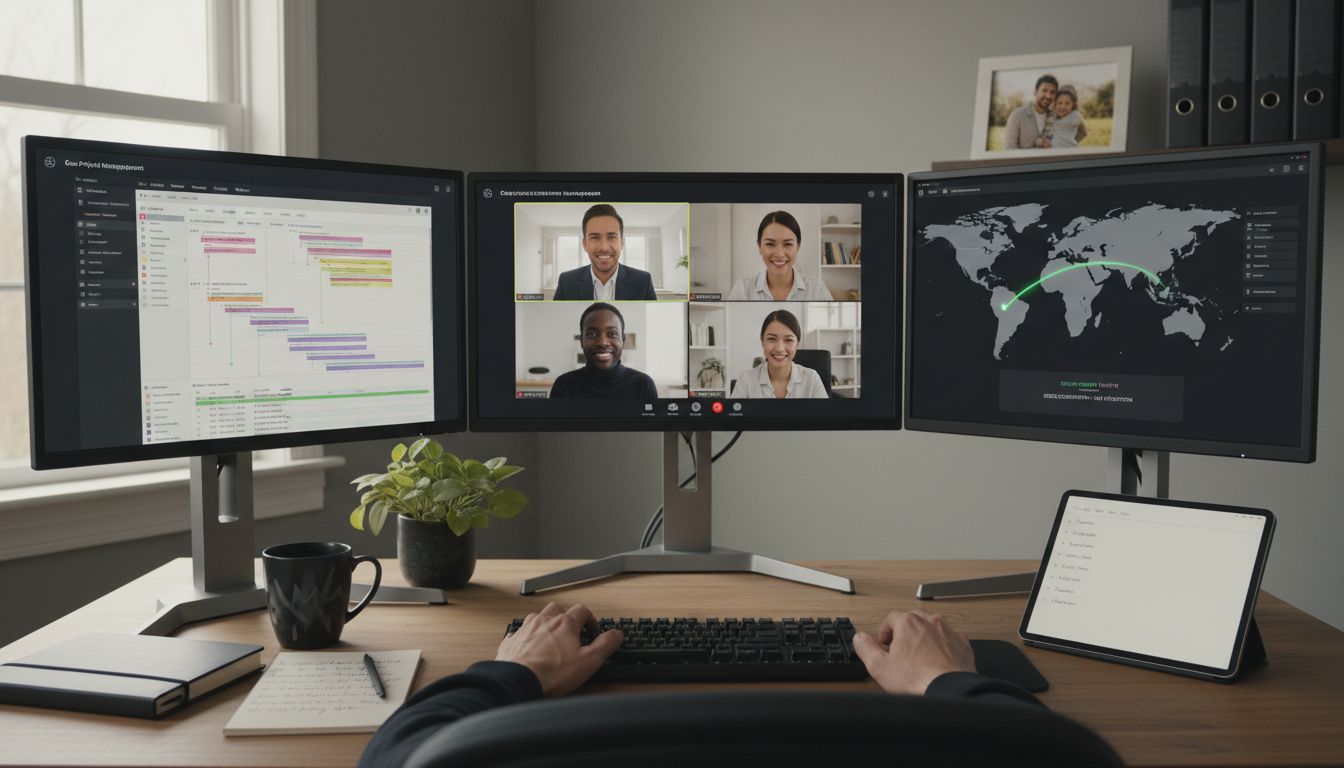
As remote work continues to evolve, organizations must strategically invest in robust technological infrastructures. Learn more about enterprise mobility trends to understand how cutting-edge technologies are reshaping workplace dynamics. The most successful companies will be those that view technology not just as a tool, but as a fundamental enabler of flexible, efficient, and collaborative work models.
Enterprise Security, Compliance, and Legal Risks
Remote work environments introduce complex security and legal challenges for modern enterprises. Wikipedia highlights that remote work significantly impacts organizational security, requiring comprehensive strategies to address data protection, secure communication channels, and compliance with diverse labor regulations across different jurisdictions.
Legal risks associated with remote staffing are multifaceted and demand strategic management. According to Wikipedia, organizations must navigate intricate challenges when hiring employees through third-party vendors, which necessitates:
- Robust data security protocols
- Clear intellectual property agreements
- Comprehensive employment regulation compliance
- Detailed contractual frameworks
- Cross-jurisdictional legal considerations
Enterprise security in remote work extends beyond traditional perimeter-based protection models. Organizations must develop holistic approaches that integrate technological solutions, policy frameworks, and continuous employee training. This involves implementing advanced encryption, multi-factor authentication, secure virtual private networks, and comprehensive cybersecurity awareness programs that adapt to evolving digital threat landscapes.
Learn about essential cybersecurity strategies to protect your organization’s digital assets. Successful enterprises recognize that managing legal and security risks requires a proactive, integrated approach that balances technological innovation with rigorous compliance standards, ultimately creating a secure and flexible work environment.

Optimizing Productivity in Distributed Teams
Distributed team productivity requires a strategic approach that transcends traditional workplace management. Wikipedia emphasizes the critical importance of leveraging communication technologies to facilitate collaboration, establishing clear goals, and cultivating a culture of trust and accountability among team members working across different locations.
According to Wikipedia, remote work can significantly enhance productivity by eliminating commuting time and providing employees with greater flexibility. However, this potential can only be realized through effective management practices that address key challenges such as:
- Maintaining team cohesion
- Ensuring clear communication
- Establishing transparent performance metrics
- Creating inclusive virtual collaboration environments
- Providing consistent technological support
Successful distributed teams implement comprehensive strategies that go beyond simple technological solutions. This involves developing robust communication protocols, creating opportunities for virtual team building, and designing performance management systems that focus on outcomes rather than time spent working. Leaders must become adept at creating psychological safety, fostering engagement, and providing the necessary tools and support for remote team members to excel.
Learn about proven strategies for increasing team productivity to transform your distributed workforce. The most effective organizations recognize that optimizing productivity in remote teams is a holistic process that requires continuous adaptation, empathetic leadership, and a commitment to creating a supportive, goal-oriented work culture.
Empower Your Remote Work Environment with Advanced PDF and Adobe Solutions
The future of remote work hinges on seamless communication, efficient document handling, and robust workflow automation. This article reveals challenges like maintaining productivity, securing sensitive data, and optimizing collaboration across virtual teams. At Mapsoft.com, we understand these pain points and offer specialized tools designed to transform your document management and Adobe application workflows, making remote and hybrid work smoother and more productive.

Discover how our powerful Acrobat plugins and the Mapsoft PDF Hub web platform help you automate large-scale PDF processing, secure files, and streamline collaboration. Don’t let fragmented document workflows slow your distributed teams down. Visit Mapsoft.com now to unlock advanced PDF tools and tailored software development solutions that empower your remote workforce. Take control of your digital documents and enhance productivity today.
Frequently Asked Questions
What is remote work?
Remote work, also known as telecommuting, is an arrangement where employees perform job duties outside traditional office settings, typically from home or other locations, using advanced communication technologies.
How do virtual teams operate in a remote work environment?
Virtual teams operate by collaborating across various geographic locations through communication technologies such as email, instant messaging, and video conferencing to achieve common organizational goals.
What are the benefits of hybrid work models?
Hybrid work models blend traditional office work with remote strategies, allowing for flexible scheduling, increased employee satisfaction, and reduced infrastructure costs, leading to enhanced productivity and collaboration.
What technologies are essential for effective remote work?
Essential technologies for remote work include collaboration tools like email platforms, instant messaging applications, video conferencing tools, cloud-based document sharing systems, and project management software that enable seamless communication and collaboration.