
Over ninety percent of large financial firms depend on PDF technology to safeguard compliance and operational efficiency across global markets. For American IT managers, the pressure to manage document workflows while navigating strict regulatory environments only increases as data volume grows. This article reveals how advanced PDF processing and intelligent automation can help financial organizations achieve airtight records, streamline compliance, and strengthen risk management.
Table of Contents
- PDFs In Finance: Core Concepts And Benefits
- Key Types Of PDFs And Workflow Applications
- Advanced PDF Processing And Legal Compliance
- Security, Privacy, And Risk Management In PDFs
- Automation Strategies For IT Managers
Key Takeaways
| Point | Details |
|---|---|
| Importance of PDFs | PDFs are essential in finance for ensuring data integrity, security, and compliance with regulations. They provide a reliable format for sharing sensitive information across platforms. |
| Types and Applications | Different types of PDFs serve specific functions in financial workflows, enhancing operational efficiency and document management. Archival, interactive, and secured PDFs each have unique benefits. |
| Advanced PDF Technologies | Utilizing advanced PDF processing and AI tools allows financial institutions to ensure compliance and streamline document review processes. Automation in this area enhances accuracy and reduces operational burdens. |
| Security Protocols | Robust security measures, including encryption, access controls, and automated monitoring, are crucial for protecting sensitive financial documents from data breaches. Regular audits are recommended to safeguard PDF management systems. |
PDFs in Finance: Core Concepts and Benefits
In the complex world of financial services, PDF documents have emerged as a critical technology for maintaining data integrity, security, and regulatory compliance. Financial institutions rely on PDFs to create standardized, unalterable records that support critical business processes across global markets. Understanding PDF formats for legal documents reveals how these digital files become foundational to modern financial communication and record-keeping.
PDFs serve multiple essential functions in finance, providing a universal format that preserves document structure, ensures data protection, and supports regulatory requirements. They enable financial professionals to share sensitive information with confidence, knowing that the document’s formatting, signatures, and content remain precisely consistent across different platforms and devices. The time value of money principles underscore the importance of accurate, reliable documentation, and PDFs meet this critical need by offering robust security features that prevent unauthorized modifications.
Key benefits of PDFs in financial services include:
- Consistent formatting across all devices and operating systems
- Advanced encryption and security protocols
- Permanent document preservation
- Digital signature capabilities
- Compliance with international financial reporting standards
Financial institutions leverage PDFs not just as document containers, but as strategic tools for risk management, audit trails, and transparent communication. These digital documents create a traceable record of transactions, agreements, and regulatory filings that can be securely archived and quickly retrieved when needed.
Pro tip: Implement a systematic PDF naming and version control protocol to streamline document management and ensure quick, accurate retrieval of critical financial records.
Key Types of PDFs and Workflow Applications
In the financial services sector, PDF documents play a crucial role in creating structured, secure, and compliant workflow systems. Different types of PDFs serve specific functions, enabling organizations to manage complex document processes with precision and reliability. Workflow management systems in financial institutions integrate diverse PDF formats to streamline critical business operations from document origination through final approval.
The primary categories of PDFs used in financial workflows include:
- Archival PDFs: Permanent records designed for long-term storage and regulatory compliance
- Interactive PDFs: Forms and documents that allow digital data entry and processing
- Secured PDFs: Highly encrypted documents with advanced security features
- PDF/A Standards: Specialized archival formats meeting legal preservation requirements
- Linearized PDFs: Optimized for web viewing and rapid digital transmission
Financial institutions leverage these PDF types to create comprehensive workflow process automation solutions that enhance operational efficiency. These digital documents facilitate seamless information exchange, reduce manual processing errors, and provide robust audit trails for regulatory oversight. By implementing sophisticated PDF workflow applications, organizations can transform complex document management challenges into streamlined, secure business processes.

Here’s a summary comparing key PDF types and their business impacts in financial workflows:
| PDF Type | Main Purpose | Typical Use Case | Business Impact |
|---|---|---|---|
| Archival PDF | Long-term preservation | Regulatory records & compliance | Ensures auditable, legal records |
| Interactive PDF | Data entry & processing | Digital forms & client onboarding | Streamlines workflow, reduces errors |
| Secured PDF | Confidentiality | Contracts, sensitive transactions | Guards against data breaches |
| PDF/A Standard | Legal document storage | Contract archiving, audits | Complies with international rules |
| Linearized PDF | Fast web access | Online document delivery | Improves user experience, speed |
Advanced PDF technologies enable financial teams to automate credit assessments, generate compliance reports, and manage sensitive information with unprecedented accuracy and control. The integration of intelligent PDF workflows allows for real-time document tracking, automatic data extraction, and sophisticated routing mechanisms that adapt to complex organizational requirements.
Pro tip: Develop a standardized PDF naming convention and metadata tagging strategy to dramatically improve document searchability and workflow efficiency.
Advanced PDF Processing and Legal Compliance
In the rapidly evolving financial services landscape, advanced PDF processing has become a critical tool for ensuring legal compliance and operational efficiency. Artificial Intelligence powered document analysis now enables financial institutions to automate complex compliance tasks, including anti-money laundering checks, sanctions screening, and fraud detection with unprecedented accuracy and speed.
Key advanced PDF processing capabilities that support legal compliance include:
- Automated clause extraction and analysis
- Real-time regulatory standard verification
- Machine learning-driven risk assessment
- Multi-jurisdictional document consistency checks
- Intelligent redaction and confidential information management
The integration of AI technologies transforms traditional document management approaches. Advanced AI-driven PDF tools facilitate comprehensive legal compliance by enabling swift, accurate contract analysis, supporting multi-user collaboration, and maintaining robust audit trails. These intelligent systems can automatically detect potential regulatory violations, track document versions, and ensure consistent adherence to evolving legal standards across complex financial ecosystems.
Financial organizations are increasingly relying on sophisticated PDF processing technologies to navigate the intricate landscape of international regulations. By leveraging machine learning and natural language processing, these tools provide real-time insights, reduce human error, and create a more transparent, accountable document management environment that meets the most stringent compliance requirements.
Below is a quick reference chart highlighting advanced PDF processing capabilities and their compliance benefits:
| Capability | Compliance Benefit | Automation Potential |
|---|---|---|
| Automated clause extraction | Detects non-compliant language | Speeds regulatory review |
| Real-time verification | Immediate legal standards checks | Reduces manual oversight |
| Machine learning risk assess | Flags fraud and risk factors | Auto-escalates suspicious items |
| Intelligent redaction | Protects sensitive information | Prevents data leaks |
| Version tracking | Maintains audit trail integrity | Simplifies external scrutiny |
Pro tip: Implement a periodic review and update cycle for your PDF processing AI tools to ensure continuous alignment with the latest regulatory changes and emerging legal standards.
Security, Privacy, and Risk Management in PDFs
In the financial services sector, document security has become a critical priority in an increasingly complex digital landscape. Emerging security challenges in financial technologies highlight the sophisticated risks associated with PDF document management, particularly the potential for cyberattacks and data breaches that can compromise sensitive financial information.
Key security strategies for managing PDF documents in financial services include:
- Advanced encryption protocols
- Multi-factor authentication
- Granular access controls
- Comprehensive audit trail tracking
- Real-time threat detection mechanisms
- Secure document versioning
- Automated compliance monitoring
Risk management frameworks outlined by the U.S. Department of the Treasury emphasize the critical importance of proactive cybersecurity measures. Financial institutions must implement robust protection strategies that go beyond traditional security approaches, integrating advanced technologies like blockchain and artificial intelligence to create multi-layered defense systems for sensitive PDF documents.
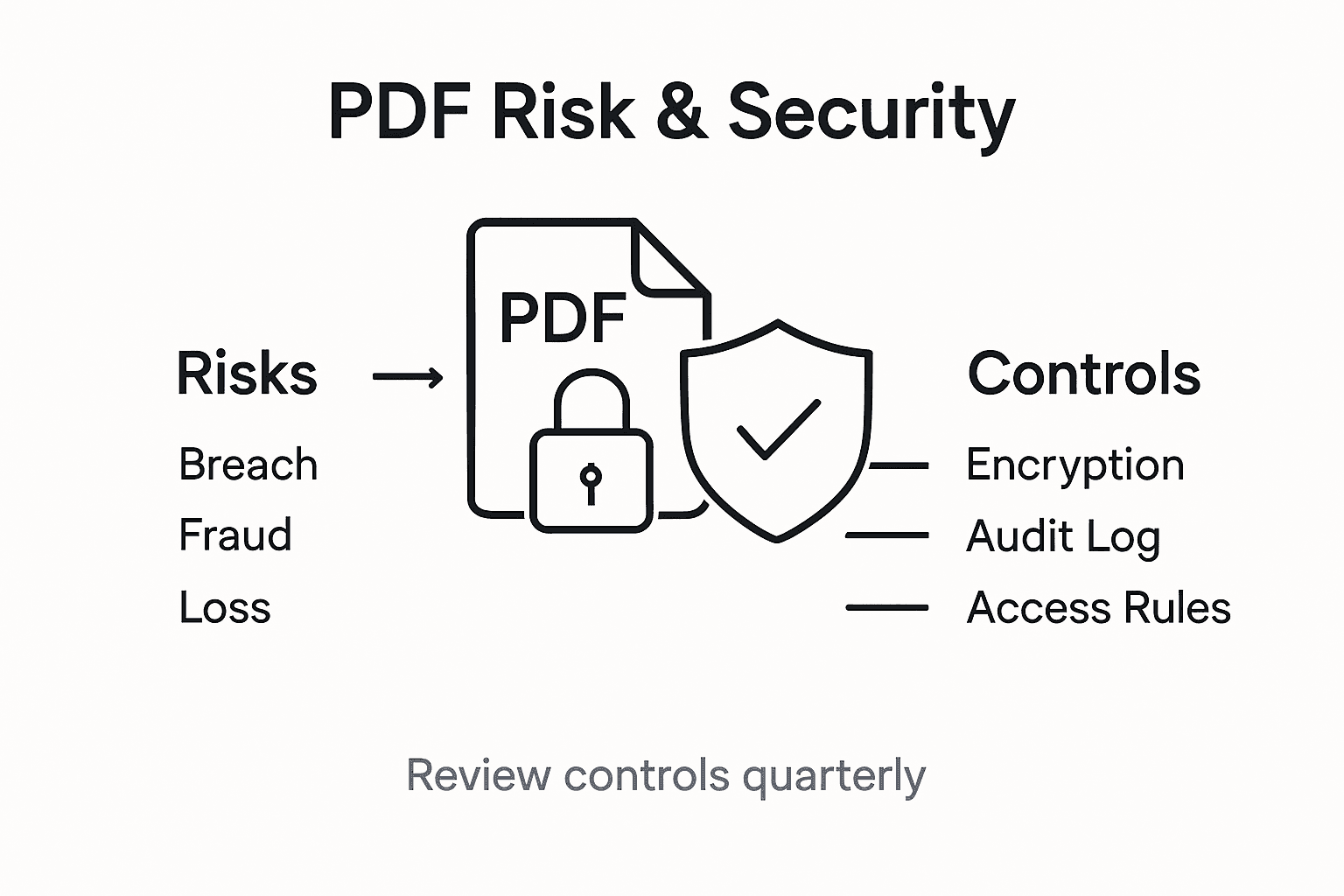
The intersection of privacy, security, and regulatory compliance demands a holistic approach to PDF risk management. Financial organizations must develop adaptive security frameworks that can quickly respond to emerging threats, protect confidential information, and maintain the integrity of digital documents across complex technological ecosystems. This requires continuous investment in cutting-edge security technologies and ongoing staff training to mitigate potential vulnerabilities.
Pro tip: Conduct quarterly comprehensive security audits of your PDF management systems to identify and address potential vulnerabilities before they can be exploited.
Automation Strategies for IT Managers
In the rapidly transforming financial technology landscape, strategic automation has become a critical imperative for IT managers seeking to optimize organizational efficiency. Developing comprehensive automation strategies involves integrating advanced technologies like robotic process automation (RPA), intelligent workflows, and sophisticated orchestration platforms to streamline complex operational processes.
Key automation implementation strategies for IT managers include:
- Comprehensive process mapping and identification of repetitive tasks
- Selecting appropriate automation technologies
- Designing scalable workflow architectures
- Implementing robust governance frameworks
- Establishing continuous monitoring and improvement mechanisms
- Creating cross-functional automation implementation teams
- Developing metrics for measuring automation effectiveness
Intelligent automation roadmaps emphasize a phased approach that transitions organizations from manual processes to highly automated, AI-driven operational models. Successful implementation requires a strategic vision that balances technological capabilities with organizational readiness, focusing on incremental improvements and building institutional knowledge throughout the transformation journey.
Modern IT managers must adopt a holistic perspective on automation, recognizing that technological solutions are not just about replacing human tasks but about creating more intelligent, responsive, and adaptive organizational systems. This approach demands continuous learning, agile implementation strategies, and a commitment to developing workforce skills that complement emerging automated technologies.
Pro tip: Create a cross-functional automation task force that includes representatives from IT, operations, and compliance to ensure comprehensive and aligned automation strategy development.
Enhance Financial Compliance and Security with Advanced PDF Solutions
Financial services face mounting challenges in securing sensitive documents while ensuring strict regulatory compliance. This article highlights pain points such as maintaining immutable records, automating compliance checks, and protecting confidential information through robust PDF workflows. Concepts like secure PDFs, digital preservation, and AI-driven document processing show the critical need for reliable tools that streamline these complex tasks without sacrificing accuracy or speed.
At Mapsoft, we specialize in addressing these exact challenges by offering tailored solutions that leverage Adobe technologies to optimize PDF handling for financial institutions. Whether you need advanced encryption, automated workflow creation, or comprehensive digital preservation strategies, our platform and expert services empower you to stay ahead in security and compliance mandates.
Discover how our comprehensive offerings can transform your financial document management. Explore the Digital Preservation category for insights and tools to safeguard your records.

Take control of your financial document workflows today. Visit Mapsoft.com to explore specialized plugins, web-based PDF solutions, and custom development services designed to secure your data and boost operational efficiency. Streamline your compliance processes before complexity grows and regulations tighten further.
Frequently Asked Questions
What are the key benefits of using PDFs in financial services?
PDFs provide consistent formatting across devices, advanced encryption and security, permanent document preservation, digital signature capabilities, and compliance with international financial reporting standards, making them essential for data integrity and regulatory compliance.
How do advanced PDF technologies enhance compliance in financial services?
Advanced PDF technologies automate tasks like clause extraction, real-time regulatory verification, and risk assessment, which streamline compliance processes and reduce human error, ensuring that organizations adhere to legal standards effectively.
What types of PDFs are commonly used in financial workflows?
Common types of PDFs in financial services include archival PDFs for long-term compliance, interactive PDFs for data entry, secured PDFs to protect sensitive information, PDF/A standards for legal storage, and linearized PDFs for fast web access.
What security measures can financial institutions implement for PDF document management?
Financial institutions should utilize advanced encryption protocols, multi-factor authentication, granular access controls, comprehensive audit tracking, real-time threat detection, and secure versioning to protect sensitive PDF documents and mitigate risks.