
Most organizations underestimate how quickly a single overlooked flaw can spiral into widespread disruption. Studies reveal that over 60 percent of business failures are linked to operational risks such as system breakdowns, human errors, or procedural failures. Grasping what operational risk really means is vital for protecting performance and stability. A clear understanding empowers leaders to spot hidden dangers and build solid protection before minor problems turn into costly crises.
Table of Contents
- Defining Operational Risk Clearly
- Identifying Key Risk Categories
- Building Operational Risk Mitigation Frameworks
- Embedding Risk-Aware Culture
- Technology‑Driven Risk Reduction
- Monitoring And Continuous Risk Control
Key Takeaways
| Point | Details |
|---|---|
| Understanding Operational Risk | Organizations must proactively identify and manage operational risks stemming from internal processes, human errors, system failures, and external threats. |
| Categorizing Risks | Operational risks can be classified into eight key categories, enabling targeted risk management strategies to enhance stability and resilience. |
| Building Effective Frameworks | A comprehensive risk mitigation framework should include risk identification, quantitative analysis, and real-time monitoring to adapt to evolving threats. |
| Cultivating a Risk-Aware Culture | Embedding a risk-aware culture across all levels of the organization transforms risk management into a strategic advantage and promotes proactive behavior among employees. |
Defining Operational Risk Clearly
Operational risk represents a critical vulnerability that every organization must understand and manage proactively. According to Wikipedia, operational risk refers to the potential for financial losses resulting from inadequate or failed internal processes, people, systems, or external events. This broad definition encompasses a wide spectrum of potential disruptions that can significantly impact business performance and stability.
At its core, operational risk involves identifying and mitigating potential losses that emerge from internal organizational dynamics. TechTarget highlights that these risks can stem from multiple sources, including:
- System Breakdowns: Technical failures that interrupt business continuity
- Human Errors: Mistakes made by employees during critical processes
- External Events: Natural disasters, cyber attacks, or unexpected market shifts
- Procedural Failures: Ineffective or poorly designed organizational workflows
Understanding operational risk requires a comprehensive approach that goes beyond simple risk identification. Organizations must develop robust strategies to assess, monitor, and mitigate potential vulnerabilities. This means creating systematic frameworks that can anticipate and respond to complex risk scenarios, ensuring that potential disruptions are identified and managed before they can cause significant damage to the organization’s operations or financial health.
Identifying Key Risk Categories
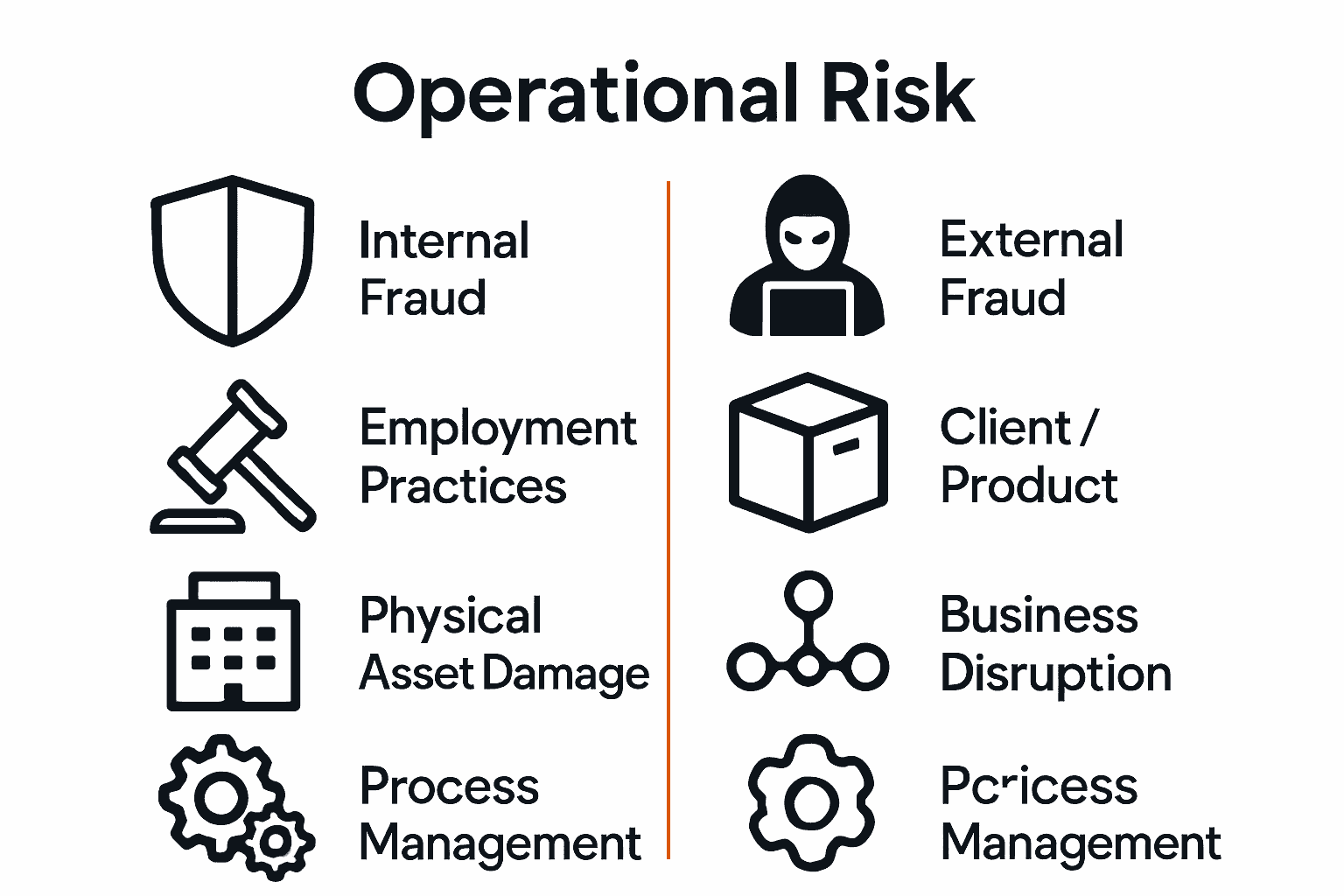
Navigating the complex landscape of operational risk requires a systematic approach to understanding its various dimensions. According to Revista Espacios, operational risk categories can be comprehensively broken down into eight distinct yet interconnected areas that organizations must carefully monitor and manage.
These key risk categories encompass a wide range of potential vulnerabilities:
- Internal Fraud: Deliberate acts of deception or misconduct by employees
- External Fraud: Malicious activities conducted by parties outside the organization
- Employment Practices: Risks related to workplace safety, discrimination, and labor regulations
- Client and Product Risks: Challenges arising from service delivery and product interactions
- Physical Asset Damage: Potential losses from destruction or impairment of organizational infrastructure
- Business Disruption: Risks associated with system failures and operational interruptions
- Execution and Process Management: Challenges in delivering services and managing complex workflows
Understanding these categories is more than an academic exercise. Each risk category represents a potential point of failure that could significantly impact an organization’s financial stability and operational integrity. By developing targeted strategies for each category, businesses can create a comprehensive risk management framework that anticipates and mitigates potential vulnerabilities before they escalate into more serious problems.
 This proactive approach transforms risk management from a defensive strategy to a strategic advantage, enabling organizations to build resilience and maintain competitive edge in an increasingly complex business environment.
Building Operational Risk Mitigation Frameworks
Constructing an effective operational risk mitigation framework requires a sophisticated and dynamic approach that goes beyond traditional static risk management strategies. Research from ArXiv reveals that operational risk models must account for complex interactions, including random noise, process interconnections, and proactive loss prevention efforts.
A robust risk mitigation framework typically includes several critical components:
- Risk Identification: Systematic mapping of potential vulnerabilities
- Quantitative Analysis: Measuring potential financial and operational impacts
- Prevention Strategies: Developing targeted interventions for each risk category
- Monitoring Systems: Continuous tracking and assessment of risk indicators
- Response Protocols: Predefined actions for mitigating identified risks
- Adaptive Mechanisms: Flexibility to adjust strategies based on emerging threats
The most advanced risk mitigation frameworks recognize that operational risks are not static but dynamic systems with complex interdependencies. By developing models that can track the evolution of potential losses and understand correlations between different organizational processes, businesses can transform risk management from a reactive discipline to a proactive strategic capability. This approach allows organizations to not just protect against potential disruptions, but to build inherent resilience into their operational infrastructure, turning risk management into a competitive advantage.
Embedding Risk-Aware Culture
Creating a robust risk-aware culture is not about implementing rules, but transforming organizational mindset and behavior. According to Wikipedia, operational risk management is a continuous process that demands seamless integration of risk awareness into daily operations and decision-making processes.
Building this culture requires strategic interventions across multiple organizational dimensions:
- Leadership Commitment: Executives must visibly champion risk awareness
- Comprehensive Training: Regular education on risk identification and mitigation
- Open Communication: Encouraging transparent reporting of potential risks
- Accountability Mechanisms: Establishing clear responsibilities for risk management
- Reward Systems: Recognizing proactive risk prevention behaviors
- Continuous Learning: Creating feedback loops that improve risk understanding
The most successful organizations understand that embedding a risk-aware culture goes beyond formal processes. As highlighted by the Institute of Operational Risk, developing professional competency is crucial. This means transforming risk management from a compliance exercise into a strategic capability where every employee becomes a sentinel, constantly scanning the organizational landscape for potential vulnerabilities. By making risk awareness an intrinsic part of organizational DNA, businesses can create resilient systems that anticipate, adapt, and respond to emerging challenges with agility and precision.

Technology‑Driven Risk Reduction
Modern organizations are increasingly turning to advanced technological solutions to transform risk management from a reactive to a predictive discipline. Research from ArXiv demonstrates that dynamic risk models can now integrate multiple information sources, combining internal data, external insights, and expert knowledge through sophisticated Bayesian inference techniques.
Key technological approaches for reducing operational risk include:
- Artificial Intelligence: Advanced algorithms that predict potential risk scenarios
- Machine Learning: Systems that continuously learn from historical risk data
- Real-Time Monitoring: Automated tracking of potential vulnerability indicators
- Predictive Analytics: Forecasting potential disruptions before they occur
- Integrated Risk Platforms: Centralized systems that consolidate risk information
- Automated Compliance Checking: Tools that instantly validate operational procedures
The future of risk reduction lies in sophisticated technological frameworks that can dynamically adapt to changing organizational landscapes. As highlighted by emerging research from ArXiv, comprehensive risk taxonomies now enable organizations to identify and categorize risks with unprecedented granularity. By leveraging advanced technologies, businesses can transform risk management from a defensive strategy into a proactive, intelligence-driven approach that not only prevents potential threats but also creates competitive advantages through enhanced organizational resilience.
Monitoring And Continuous Risk Control
Continuous risk control represents the heartbeat of modern operational risk management, transforming traditional reactive approaches into dynamic, responsive systems. According to research from ArXiv, dynamical risk measurement allows organizations to track the evolution of potential losses and understand complex correlations between different organizational processes in real-time.
Effective continuous monitoring requires a multifaceted approach that includes:
- Real-Time Data Collection: Capturing instantaneous risk indicators
- Automated Alert Systems: Triggering immediate notifications for potential risks
- Predictive Threshold Modeling: Establishing early warning mechanisms
- Comprehensive Process Tracking: Monitoring interactions between different organizational systems
- Adaptive Response Protocols: Developing flexible intervention strategies
- Granular Performance Metrics: Measuring risk management effectiveness
Research from ArXiv highlights that advanced operational risk models now enable organizations to perform parameter estimation from real data, transforming risk control from a static compliance exercise into a dynamic, intelligence-driven process. By implementing sophisticated monitoring frameworks, businesses can create proactive risk management systems that not only detect potential vulnerabilities but also anticipate and mitigate emerging threats before they can cause significant operational disruption.
Strengthen Your Operational Risk Management with Seamless PDF and Workflow Solutions
Reducing operational risk starts with mastering your internal processes and building resilience across every workflow. The challenges highlighted in the article—such as managing complex procedural failures, ensuring continuous monitoring, and embedding a risk-aware culture—demand tools that streamline and secure your essential document operations. At Mapsoft, we understand how operational risks can arise from inefficient handling of critical files and disorganized workflows, which can lead to costly errors or downtime.

Boost your risk mitigation strategy by integrating specialized PDF and Adobe Acrobat solutions designed to automate and safeguard your document processes. From effortless PDF editing to advanced batch workflow automation on our Mapsoft PDF Hub, you gain full control over document integrity and compliance. Explore how our custom plugins and consultancy services at Mapsoft.com empower your organization to reduce human error, improve operational monitoring, and respond faster to emerging risks. Don’t wait for disruptions to impact your business. Visit Mapsoft.com now to build smarter workflows that protect your bottom line today.
Frequently Asked Questions
What is operational risk?
Operational risk refers to the potential for financial losses due to inadequate or failed internal processes, people, systems, or external events. It encompasses a wide spectrum of disruptions that can impact business stability.
How can organizations identify operational risks?
Organizations can identify operational risks by systematically mapping potential vulnerabilities across various categories such as internal fraud, external fraud, employment practices, and business disruptions, among others.
What are the components of an effective operational risk mitigation framework?
A robust operational risk mitigation framework includes risk identification, quantitative analysis, prevention strategies, monitoring systems, response protocols, and adaptive mechanisms to adjust strategies based on emerging threats.
How can technology help in reducing operational risk?
Technology can aid in reducing operational risk by utilizing artificial intelligence, machine learning, real-time monitoring, predictive analytics, integrated risk platforms, and automated compliance checking, thus transforming risk management from reactive to predictive.