
Managing sensitive documents in highly regulated sectors often means facing the constant challenge of maintaining integrity, accessibility, and security across complex workflows. For compliance officers, choosing the right digital format can spell the difference between smooth regulatory audits and costly oversights. With roots in Adobe’s Camelot Project, the PDF’s fixed layout and robust security features ensure that every critical record remains consistent, authentic, and protected. Discover how modern PDF standards and automation empower compliance in healthcare, finance, and legal environments.
Table of Contents
- Defining PDFs in Regulated Industries
- Types of PDF Standards and Compliance
- Workflow Automation for Regulatory Demands
- Security, Privacy, and Auditability Requirements
- Risks, Legal Exposure, and Compliance Failures
Key Takeaways
| Point | Details |
|---|---|
| Importance of PDFs | PDFs serve as a critical compliance mechanism in regulated industries, ensuring document integrity and security. |
| PDF Standards | Various ISO PDF standards cater to specific industry needs, enhancing document reliability and compliance. |
| Workflow Automation | Implementing automation in document management helps reduce errors and maintain compliance with regulations. |
| Compliance Risks | Non-compliance can result in significant legal and financial repercussions, emphasizing the need for rigorous document management strategies. |
Defining PDFs in Regulated Industries
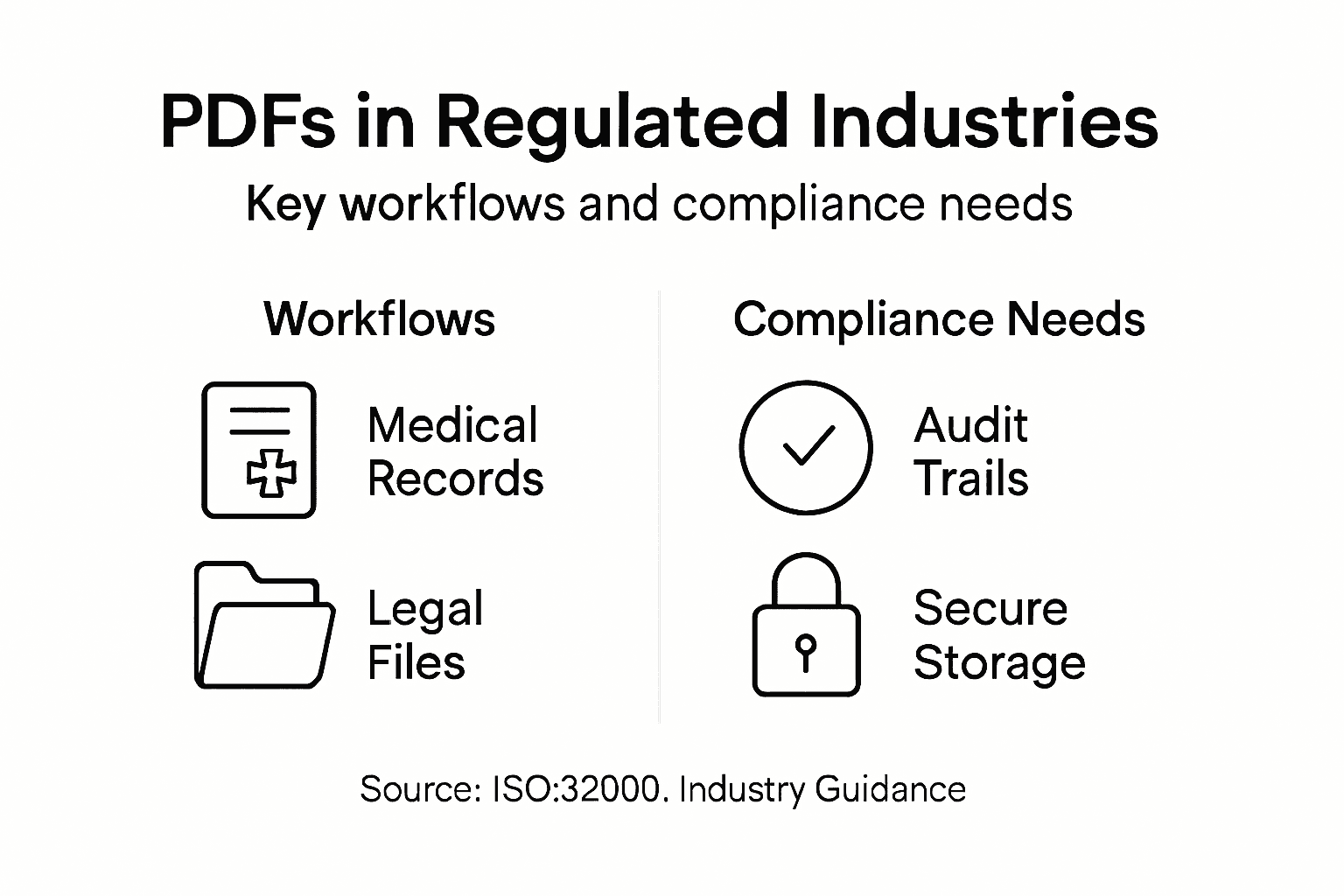
Portable Document Format (PDF) files represent more than just a digital document type – they are a critical compliance mechanism for organizations operating in highly regulated environments. Originating from Adobe’s 1991 Camelot Project, PDFs have evolved into a standardized file format that preserves document integrity, formatting, and security across diverse technological platforms.
In regulated industries like healthcare, finance, and legal services, PDFs serve as a robust documentation standard with several key characteristics:
- Fixed layout preservation that ensures consistent visual representation
- Embedded security features like encryption and digital signatures
- Long-term archival compatibility across different software and hardware systems
- Tamper-evident capabilities that maintain document authenticity
The international standardization of PDFs through ISO 32000 further reinforces their credibility in compliance-sensitive sectors. Unlike editable document formats, PDFs create a “snapshot” of information that cannot be accidentally modified, which is crucial for maintaining regulatory documentation standards.
Regulated industries rely on PDFs for critical workflows that demand precise document control. Whether it’s medical records, financial statements, or legal contracts, these files provide a secure, consistent method of information exchange that meets stringent compliance requirements.
Pro tip: Always verify that your PDF creation and management tools support industry-specific compliance standards and encryption protocols.
Types of PDF Standards and Compliance
The International Organization for Standardization (ISO) has developed multiple specialized PDF standards for specific industry needs, addressing unique regulatory requirements across different sectors. These standardized PDF subsets ensure document integrity, accessibility, and long-term preservation in highly regulated environments.
Key PDF standards include:
- PDF/A: Designed for long-term digital archiving
- PDF/E: Optimized for engineering and technical documentation
- PDF/UA: Focused on universal accessibility for individuals with disabilities
- PDF/X: Specialized for professional printing workflows
Each PDF standard serves a distinct purpose in maintaining compliance and document reliability. For instance, PDF/A mandates the embedding of all necessary fonts and restricts certain dynamic content to guarantee perfect reproduction across different platforms and time periods. This makes it particularly valuable for industries like healthcare, legal services, and government agencies that require precise, unchangeable record-keeping.

The rigorous specifications of these PDF standards provide organizations with a robust framework for managing digital documents. By selecting the appropriate PDF standard, businesses can ensure that their electronic documents meet specific regulatory requirements, maintain consistent formatting, and preserve critical information with the highest level of authenticity and security.
Here’s a summary comparing the major PDF standards and their primary use cases in regulated industries:
| PDF Standard | Purpose | Common Industry Application |
|---|---|---|
| PDF/A | Long-term archiving | Healthcare, Legal, Government |
| PDF/E | Engineering documents | Architecture, Manufacturing |
| PDF/UA | Universal accessibility | Public Sector, Education |
| PDF/X | Professional printing | Publishing, Marketing |
Pro tip: Regularly audit your PDF creation processes to confirm alignment with the most current industry-specific PDF standards and compliance requirements.
Workflow Automation for Regulatory Demands
Workflow automation in highly regulated industries represents a critical strategy for maintaining compliance, reducing errors, and enhancing operational efficiency. By implementing sophisticated digital processes, organizations can transform their document management approach, ensuring consistent adherence to complex regulatory requirements.
Key benefits of workflow automation in regulated environments include:
- Standardized document processing that eliminates manual inconsistencies
- Real-time audit trail generation for comprehensive tracking
- Rapid adaptation to regulatory changes
- Enhanced data integrity and security
- Reduced human error in critical documentation
Advanced workflow automation technologies enable organizations to create sophisticated document management systems that automatically apply compliance checks, validate critical information, and maintain precise records. These systems integrate multiple compliance requirements, such as digital signatures, metadata verification, and version control, into a seamless operational framework.
Modern regulatory environments demand more than simple digitization. Sophisticated workflow automation platforms leverage artificial intelligence and machine learning to predict potential compliance risks, automatically flag potential issues, and ensure that every document meets stringent industry standards. By transforming manual processes into intelligent, automated workflows, businesses can significantly reduce the administrative burden while maintaining the highest levels of regulatory compliance.
The following table highlights how workflow automation addresses key regulatory challenges:
| Regulatory Challenge | Impact Without Automation | Value of Automation |
|---|---|---|
| Manual errors | Increased compliance risk | Reduced human mistakes |
| Audit traceability | Difficult to monitor | Automated audit logs |
| Regulatory changes | Slow adaptation | Rapid process updates |
| Data security | Potential vulnerabilities | Integrated safeguards |
Pro tip: Implement a pilot automation program in one departmental workflow to validate effectiveness before full-scale organizational deployment.
Security, Privacy, and Auditability Requirements
PDF standards for regulated industries demand comprehensive security protocols that protect sensitive information while maintaining complete transparency and accountability. These stringent requirements ensure that digital documents meet the highest levels of data protection, privacy compliance, and regulatory oversight.
Critical security features in regulated document management include:
- End-to-end encryption protecting data during transmission and storage
- Secure digital signature verification mechanisms
- Immutable document version control
- Comprehensive metadata tracking
- Access control and user authentication
Modern PDF technologies incorporate advanced security measures that go beyond traditional document protection. These systems create multilayered defense mechanisms that prevent unauthorized access, track document interactions, and maintain an unalterable record of all document-related activities. By implementing robust authentication protocols and granular permission settings, organizations can ensure that sensitive information remains confidential while providing auditable trails for regulatory compliance.
Privacy requirements in regulated industries demand more than just technical safeguards. Sophisticated PDF management systems must integrate accessibility standards, support redaction capabilities, and provide comprehensive documentation of all interactions. This approach ensures that organizations can demonstrate compliance with complex regulatory frameworks while protecting individual privacy and maintaining the integrity of critical business information.
Pro tip: Conduct quarterly security audits of your PDF management systems to identify and address potential vulnerabilities before they become compliance risks.
Risks, Legal Exposure, and Compliance Failures
Compliance failures in regulated industries represent significant legal and financial risks that can devastate organizational reputation and operational stability. These failures extend far beyond simple procedural mistakes, potentially triggering substantial financial penalties, legal actions, and long-term institutional damage.
Key risks associated with non-compliance include:
- Substantial monetary penalties from regulatory bodies
- Potential legal proceedings against organizational leadership
- Loss of operational licenses or certifications
- Reputational damage impacting stakeholder trust
- Mandatory corrective action requirements
The complexity of regulatory environments demands proactive, sophisticated document management strategies. Organizations must develop robust systems that not only meet current compliance standards but also demonstrate the ability to adapt quickly to evolving regulatory landscapes. This requires continuous monitoring, comprehensive documentation, and a culture of regulatory awareness that permeates every level of the organization.
Beyond immediate financial consequences, compliance failures can trigger cascading effects that undermine an organization’s credibility. Regulatory investigations often reveal systemic vulnerabilities, which can lead to increased scrutiny, mandatory external audits, and prolonged operational disruptions. The most successful organizations view compliance not as a checkbox exercise, but as a critical strategic imperative that requires ongoing investment in technology, training, and governance frameworks.
Pro tip: Implement a cross-functional compliance review committee that meets quarterly to assess and anticipate potential regulatory risks.
Enhance Compliance and Efficiency with Advanced PDF Solutions
Navigating the complex requirements of regulated industries demands reliable tools that ensure document security, authenticity, and workflow automation. This article highlights challenges like maintaining PDF/A archival standards, securing sensitive information with encryption, and automating workflows to reduce human error and compliance risks. At Mapsoft, we understand the critical importance of these goals. Our expertise in Adobe technologies and specialized PDF handling solutions empower organizations to streamline document processes with confidence.
Discover how our offerings, including custom Acrobat plugins, PDF creation and editing tools, and the Mapsoft PDF Hub for large-scale PDF processing, align perfectly with regulatory demands. By integrating Digital Preservation best practices and leveraging our comprehensive platform at Mapsoft.com, your business can achieve stronger compliance, enhanced security, and efficient document workflows. Take the next step to secure your organization’s future by exploring our customizable solutions built specifically for regulated environments.
Frequently Asked Questions
What are the benefits of using PDFs in regulated industries?
PDFs offer fixed layout preservation, embedded security features, long-term archival compatibility, and tamper-evident capabilities, making them ideal for compliance in highly regulated sectors like healthcare, finance, and legal services.
What are the different PDF standards relevant to compliance?
Key PDF standards include PDF/A for long-term archiving, PDF/E for engineering documentation, PDF/UA for universal accessibility, and PDF/X for professional printing, each designed to address specific regulatory requirements.
How does workflow automation enhance compliance in regulated environments?
Workflow automation improves document processing by standardizing procedures, enabling real-time audit trails, and adapting quickly to regulatory changes, which reduces errors and enhances operational efficiency.
What security measures should be implemented for PDF management in regulated industries?
Critical security measures include end-to-end encryption, secure digital signature verification, immutable document version control, comprehensive metadata tracking, and strict access control and user authentication.